
The Clothesline Project: Giving Voice to Survivors Behind Bars
Author: Felice Upton | Connect on LinkedIn
Published October 20, 2025
The Clothesline Project: Giving Voice to Survivors Behind Bars
As Domestic Violence Awareness Month, draws to a close, I find myself reflecting on one of the most profound and impactful projects of my career. I'm sharing this story with the hope that others working in carceral spaces that house women, community organizations, and schools will consider adopting their own version of the Clothesline Project.
In 2016, I brought the idea of the Clothesline Project to the Violence Reduction Subcommittee of the Women's Village at the Washington Corrections Center for Women. The Village is a leadership group composed of incarcerated leaders with a staff advisor; a role I had the honor of serving in for five years. Together we did a lot of cool work over those years, and this was one of my favorite projects.
The women embraced the idea immediately. Since we couldn't use actual shirts, we adapted: we cut out what felt like a gazillion paper shirts and distributed them throughout the living units. This modification didn't diminish the power of the project. If anything, it amplified our creativity and determination. Did we complain about the cutting. Yep. Did we overthink how to keep them confidential? Also, yes.
Why This Matters
I've always believed in the power of taking back control from those who have hurt us—reclaiming the narrative from the words hurled at us during our abuse. This belief is especially crucial when you consider that approximately 97% of incarcerated women have experienced serious violence and trauma.
While women make up only about 7% of the national prison population, they are NOT a statistic- they are whole people. They are moms, they are daughters, they are unique, they matter, and they must be meaningful in every single conversation about prisons and prison reform. Their pathways into and out of incarceration are distinct, their needs are specific, and their voices deserve to be heard and centered in this work. If you are hosting a panel on incarceration without women at the table, please change that.
Building Bridges Through Shared Humanity
While the women were filling out their shirts, I also distributed them to staff members. My goal, both inside the facility and in the broader community, has always been the same: to help people see the humanity in one another. Violence and trauma don't discriminate, and neither should healing and recognition.
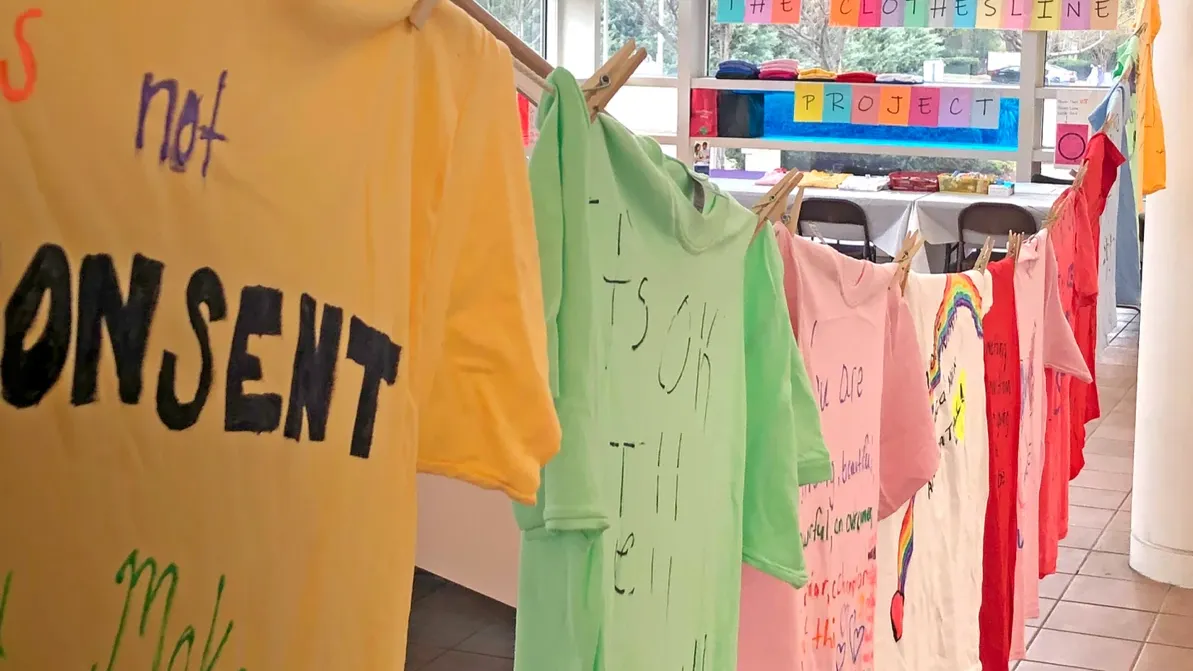
The culmination of this project was a Violence Reduction event where we invited community members to join us. Together, we filled the gymnasium with cutout paper shirts—each one representing a story, a survivor, a human being reclaiming their narrative.
Walking around that gym, reading the words of those who had experienced violence and were taking back the power from the harm inflicted upon us, was empowering. Each shirt was an act of reclamation, a refusal to let our experiences define us or keep us silent.
Your Turn: Make It Your Own
The traditional Clothesline Project uses a color code (white for those who died, yellow/beige for survivors of assault or abuse, red/pink/orange for survivors of rape or sexual assault, blue/green for survivors of incest or childhood sexual abuse, purple/lavender for those attacked because of sexual orientation) but be creative in your community. Adapt it to your space, your resources, your people.
You don't have to wait for next DV awareness month. Do it any month. Do it wherever you are. Use real shirts, paper cutouts, whatever works. The power isn't in the materials it's in elevating the voices of survivors and helping them take back the power from what was said to them in their abuse.
If your prison or school or community organization isn't empowering those it serves to thoughtfully engage and participate in creating community, I urge you to consider it. These moments of collective healing and shared voice don't just benefit individuals; they transform entire communities.
I invite you to share photos of your Clothesline Projects in the comments or just make a shirt and take a selfie or one without you in it. I am glad to post anonymously here for you. Show us how you've adapted this powerful tool in your community. Let's create a tapestry of healing that spans far beyond any single gym, any single institution, any single month.
Let's continue creating spaces where survivors can share their stories, where healing is possible, and where we recognize the profound humanity in everyone, regardless of where they are in their journey.
What projects or initiatives have you found meaningful in supporting survivors of domestic violence? Share your Clothesline Projects or other community-building efforts in the comments.
