
What Implementation Really Asks of People
Author: Felice Upton | Connect on LinkedIn
Published December 29, 2025
And why so many initiatives quietly fail
A few weeks after returning from maternity leave, I went back to work as a nursing mother.
I was already carrying the familiar mix of emotions many parents know well. Sadness about leaving my baby. Guilt about wanting to stay home longer. Determination to keep showing up as a leader. Dealing with a breast pump while going in and out of prisons where I did investigations (that could be a whole book.)
I was working on the third floor of a community justice center when loud blasts interrupted the day.
At first, no one knew exactly what was happening.
We began evacuating down the stairwell, trying to assess whether there was an active shooter on the second floor. Before we reached the first floor, we learned that an IED had been deployed in the parking lot.
I made the decision to turn the group I was leading back up to the third floor.
We were instructed to shelter in place.
For two hours, three of us hid under one desk.
And while we waited, my thoughts were not about protocols or performance. They were about my baby. About whether I had made the right choices. About why my life insurance wasn't higher. About what would happen to my child if I didn't make it home.
The next day, I sent an email to my supervisor asking whether I could work from an alternate location until my life insurance coverage was increased. Not because I didn't believe in the mission, but because the risk had become painfully real.
What happened next changed how I lead
In the days and weeks that followed, I watched carefully. I noticed which leaders checked in and which ones moved straight back to business. I noticed who created space for people to name what they were carrying, and who expected everyone to simply push through.
The moments that mattered most were not structural. They were human.
A supervisor who sat with me and asked what I needed without rushing to fix anything. A colleague who admitted she was also scared, which gave me permission to say the same. A leader who quietly adjusted workloads without making anyone ask.
These weren't policy changes. They weren't formal accommodations. They were people who understood that something had shifted and who responded to the person in front of them, not just the role.
Those moments stayed with me. They shaped how I thought about what it actually takes to lead through hard things. And they raised a question I have carried into every leadership role since: how do we stop relying on individual kindness and start building these responses into how organizations actually function?
This is what implementation feels like on the inside
We often talk about initiatives and operations as technical challenges. But implementation always lives inside human nervous systems.
It asks people to hold risk they did not design. To make real-time decisions with incomplete information. To carry responsibility beyond what is formally acknowledged. To absorb uncertainty so systems can keep moving.
When organizations fail to account for that reality, the cost doesn't show up immediately on a dashboard. It shows up later, as exhaustion, disengagement, turnover, and quiet mistrust.
Why so many good initiatives fall flat
I've seen countless well-intentioned initiatives launch with energy and optimism. The strategy is sound. The goals are worthy. The people want it to work.
What's often missing is what I've come to call human scaffolding.
Not project plans. Not org charts. The infrastructure that acknowledges people are carrying something real when they do this work.
That means pacing that reflects cognitive and emotional load, not just deadlines. Clear boundaries around responsibility and risk, so people aren't left guessing what they're accountable for when things go sideways. Leadership structures that share decision weight rather than concentrating it in a few exhausted people. And space to process impact, not just measure outcomes.
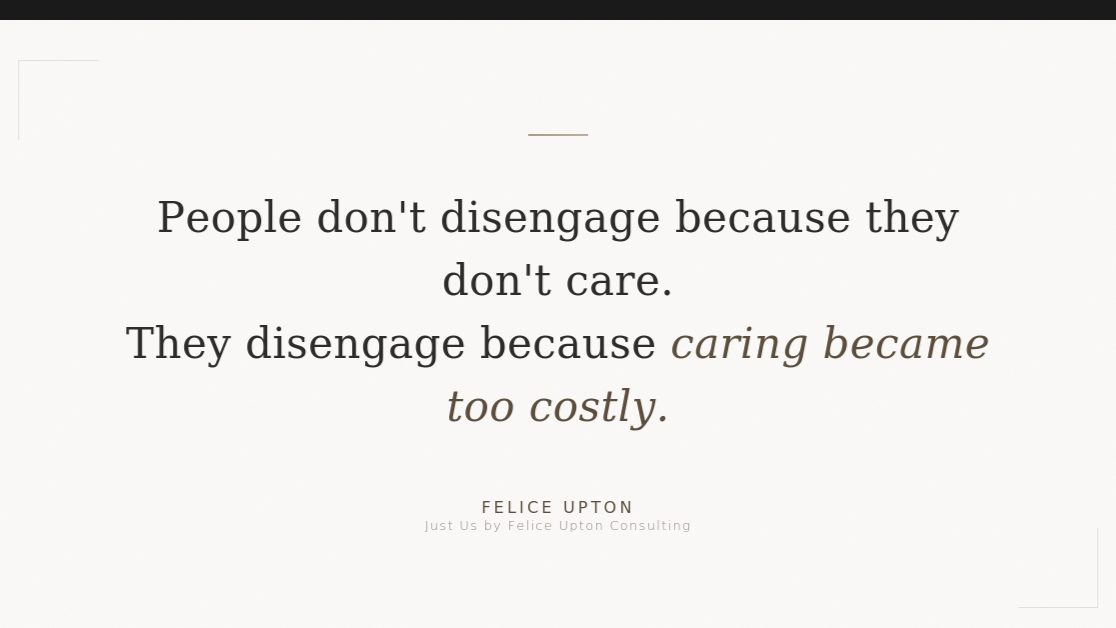
Without this, initiatives create a predictable pattern. Early buy-in, rising strain, and eventual withdrawal. People don't disengage because they don't care. They disengage because caring became too costly and no one seemed to notice.
Workforce stability is built here
One of the biggest challenges leaders face right now is workforce stability. Not hiring. Not headcount. Stability.
And stability is not achieved by hiring for volume. That approach only increases churn.
Stability is built when organizations hire deliberately for a culture that fits this moment and their long-term vision, and when they back that culture with structures that make staying possible.
That means designing roles that reflect the true demands of the work. Implementing change with attention to human capacity, not just timelines. Acknowledging the emotional labor embedded in mission-driven roles. And normalizing conversations about risk, fear, and limits before people reach the edge.
I stayed in my career after that day under the desk. I stayed because of the people who showed up for me in ways that mattered. But I also stayed because I became determined to figure out how to make that kind of response less dependent on luck and more embedded in how we lead.
Why I care so much about naming this
My experience wasn't unique. It was simply visible.
Every day, people in complex systems make decisions that carry real human risk, often without space to name what that costs them. When we don't build systems that account for that reality, we don't just burn people out. We teach them to disconnect. We lose trust. We lose wisdom. We lose the very people we depend on most.
What I want leaders to consider
Strong organizations don't rely on quiet sacrifice to succeed. They invest in scaffolding, the kind that allows people to bring their full judgment, care, and humanity without having to gamble their well-being to do so.
The leaders and colleagues who showed up for me after that day did something powerful. But it shouldn't have depended on their individual instincts. It should have been part of how the organization functioned.
That's the work I care about now. Not hoping the right people happen to be in the room, but designing systems where the right response is built in.
If your organization is struggling with retention, engagement, or implementation that keeps stalling out, the answer might not be a new strategy.
It might be asking what you're actually asking of people, and whether you've built anything to hold them while they carry it.
I'm curious what this brings up for you:
What's one moment when someone showed up for you in a way that made it possible to stay in hard work?
And if you lead others: what are you asking people to carry that you haven't fully named?
