
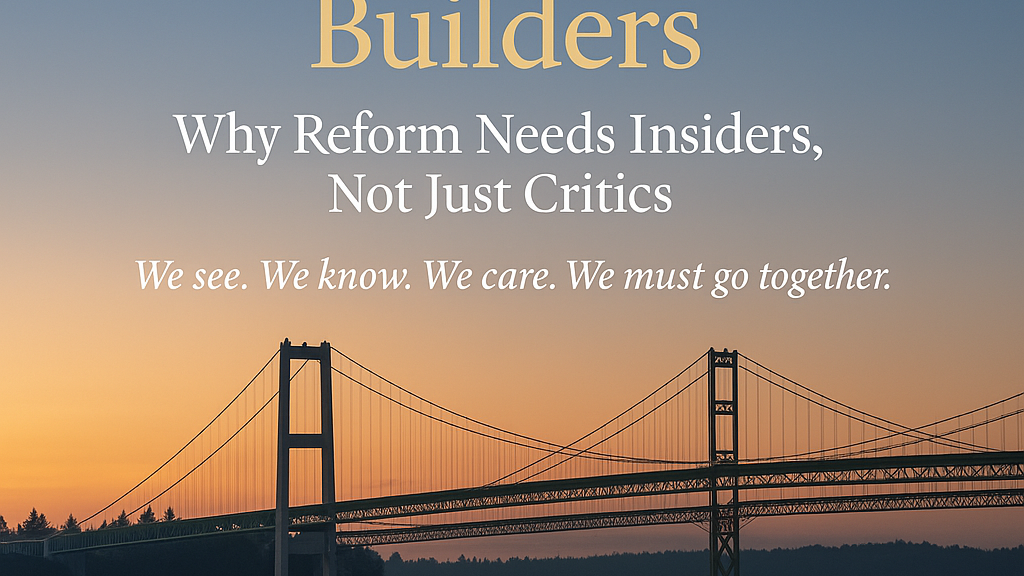
The Bridge Builders: Why Reform Needs Insiders, Not Just Critics
Author: Felice Upton | Connect on LinkedIn
Published October 31, 2025
Across the country, departments of corrections are desperate to hire and more importantly to retain employees.
Bonuses. Billboards. Job fairs. New slogans.
But hiring more people into the same culture will not solve this crisis. It will multiply it.
And here's what else won't solve it: solutions designed in boardrooms by people who've never walked a tier. Reform strategies that sound inspiring but collapse under the weight of real-world implementation. Policies created without the voices of those who actually do this work every single day.
If we want solutions that stick, we need people coming together to truly hear each other not just talk at each other. Many of us entered this work to try to move forward change from within.
The Real Shortage Isn't Staffing, It's Hope
This is the part of the conversation most people miss.
We talk about retention as if it's a spreadsheet problem. It's not. It's a culture problem. Cultures where silence, compliance with toxicity and complacency are rewarded.
People are walking away from this work not because it's hard, but because it's hopeless.
When a system treats its workforce like they are disposable, when trauma is normalized, and when caring too much is seen as a liability, people start to leave behind the parts of themselves that made them good at this work in the first place.
You can see it in the tired eyes of a veteran officer who used to believe in rehabilitation.
You can feel it in the silence after a debrief that never really lets people process what they've seen.
You can hear it in the jokes we make to survive the pain and the cynicism and the harm they carry home after really hard and short staffed days.
We have a workforce that is emotionally exhausted, not because they don't care, but because they care so deeply that the system gives them no place to put that care.
Who We Hire Shapes What We Become
If you want to know the future of corrections, look at who we recruit.
Too often, our job postings and messaging sound like we're searching for bouncers, not bridge-builders. We prioritize toughness over temperament, compliance over compassion.
And then we wonder why morale collapses.
We need people who can hold complexity. Who can de-escalate conflict without dehumanizing others. Who understand that safety is built on trust... not control.
The future of corrections won't be built by the toughest or those who cannot hold complexity.
It will be built by the most emotionally intelligent.
This Isn't About Defending a Broken System
Here's what I need people outside of this work to understand:
Most of us who have spent years in corrections are not defending the status quo. We're trying to heal it from the inside.
We've seen the harm. We've lived the impossible tension between accountability and compassion. And we stay... or stayed ...because we believe people can change. Because we want to be part of that change. We worked holidays. We were there on the bad days and the good days.
So, when the public talks about reform, I hope they remember this:
We are not the enemy. We are part of the solution.
We are parents, mentors, neighbors, and professionals trying to hold humanity inside systems that often forget their own.
What Actually Fixes This? Culture Shift, Not Hiring Spree
Recruitment bonuses won't fix what culture has broken. Pizza parties won't either.
Leadership willing to interrogate our own behaviors and really lean into systemic change will. Leaders willing to the foundational work.
We need leaders who model empathy without losing authority. Who build psychological safety the same way they build security. Who remind their teams that they are not just enforcing rules, they are shaping futures.
If we want people to stay, we have to give them a reason to. Not a paycheck. A purpose.
When staff feel trusted, valued, and part of something larger than survival, they don't burn out, they build up.
To the Community: We Must Go Together
For those outside these systems, policymakers, advocates, community members, your voices matter.
But please, don't paint all correctional staff with the same brush.
Some of the most compassionate, justice-oriented people I know wear uniforms. They carry trauma and hope. They show up because they believe redemption isn't a theory... it's a practice. In many states those incarcerated and those in uniforms come from similar socio-economic backgrounds.
Here's the truth: We need each other.
We need the perspective of people who've been incarcerated. We need advocates who hold systems accountable. We need community members who care about what happens inside these walls. And we need the staff who show up every day trying to make it better. We need brave leaders willing to break some stuff.
Not one of these voices. All of these voices.
Because solutions that don't include the people who actually work in corrections? They sound good in theory and fall apart in practice. They ignore operational realities. They miss the nuance. They create policies that look like reform but feel like punishment to the very people we're asking to implement them.
And solutions that only include corrections staff? They miss the lived experience of harm. They lose sight of who this system is supposed to serve. They perpetuate blind spots we can't afford.
Sustainable change happens when we sit together, not in opposition, but in honest conversation.
When formerly incarcerated people, frontline staff, advocates, and leadership come together to truly hear each other, we don't just get ideas that sound good. We get solutions that are actually implementable. Solutions that account for safety AND humanity. Solutions that last.
We can't reform justice by dividing staff from community. We ARE the community.
The bridge forward will not be built by blame, but by understanding.
This is why it's "Just Us." Not just you. Not just them. Just us... all of us...figuring this out together.
For Leaders Who Want to Start the Shift
If you're a leader in corrections or human services, here are a few questions worth asking:
Do your staff meetings include space for reflection and meaning, not just metrics?
Are you hiring for temperament, not just tenure?
Do your supervisors know how to listen really listen?
When was the last time you brought people with lived experience from all angles into the room to design policy with you, not just comment on it?
How are you ensuring that you are transparent?
Are you treating the presenting problem or the actual systemic issues?
Culture doesn't change because we demand it. It changes because we design for it, and we lead with hope.
And it changes when we stop pretending one perspective has all the answers. The people closest to the problem are closest to the solution, but only if we actually listen to them. All of them. Staff. People who've been incarcerated. Community members. Advocates.
That's how you get solutions that don't just sound good. That's how you get solutions that work.
Closing Reflection
The workforce crisis in corrections isn't about filling positions and while the pandemic exacerbated the crisis it existed before the pandemic as did so many of the issues that have been failed by the pendulum.
It's about restoring belief.
Belief that people, inside and outside the walls, still matter.
Belief that leadership can be compassionate and strong.
Belief that systems can heal when we center the humans who hold them together.
Belief that we can design solutions together that actually work, not just sound good on paper.
We don't need a hiring spree.
We need a culture shift.
And we don't need more people talking past each other from their separate corners.
We need diverse perspectives... from every angle of this system... sitting at the same table, really listening, and building something sustainable together.
And for that, we must go together. I will be facilitating some of these hard conversations soon. Let me know if you want to join.
Not just corrections staff. Not just advocates. Not just policymakers.
Just us.
All of us.
Felice Upton is the founder of Just Us Consulting LLC, working at the intersection of justice reform, leadership development, and human-centered culture change. We believe the best solutions come from bringing diverse perspectives together ..not just talking about collaboration but actually doing it.
Have you seen what happens when people from different perspectives really listen to each other? What solutions have you seen work because they included the people who actually do the work? I'd love to hear your stories in the comments.
#Corrections #Leadership #JusticeReform #CultureChange #WorkforceDevelopment #EmotionalIntelligence #OrganizationalCulture #HumanResources #PublicService #SystemsChange
